





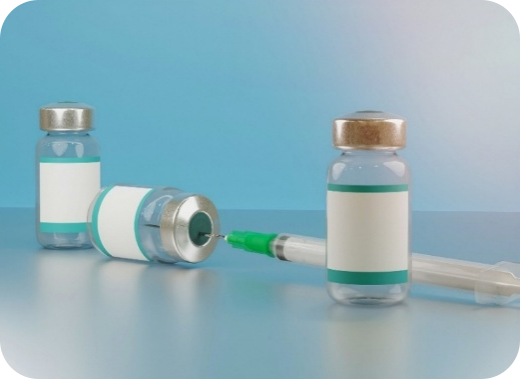
For a injectable drug, the rubber stopper is not an accessory — it is primary packaging in continuous contact with the formulation for the product's entire shelf life. That is why pharmaceutical packaging teams qualify a stopper material the way they qualify an API supplier: through documented cleanliness, functional performance, and supply reliability. This guide sets out what to verify before qualifying a halogenated butyl rubber supplier for pharmaceutical stoppers and vial seals, with the published data points that make each check concrete.
Why Halogenated Butyl Rubber Is the Default Stopper Material
Butyl rubber's extremely low gas permeability is what first made it the container-closure material of choice: it keeps air and moisture out of a vial over years of storage. Halogenation — bromination or chlorination — then solves butyl's curing limitation, giving the polymer faster, more versatile vulcanization so stopper manufacturers can achieve the elastic memory a stopper needs.
Two functional behaviors matter most for injectables. First, self-sealing after puncture: a stopper must reseal the channel created by a syringe needle through multiple penetrations, preventing leakage and microbial ingress. Second, compatibility with the formulation: the compound's additives must not migrate into the drug or react with it. Both are properties of the specific grade and its formulation recipe — not of "halogenated butyl rubber" as a family — which is exactly why supplier qualification, not generic material selection, is the task in front of you.
Bromobutyl (BIIR) and chlorobutyl (CIIR) dominate stopper compounding; between them, the choice depends on the cure system the stopper producer runs and the extractables profile the drug requires. Bromobutyl's faster cure response and the lower loading of cure additives it typically permits have made it the more common route for modern injectable stoppers, while chlorobutyl retains a firm place where an established compound or a specific extractables target favors it. A qualified supplier should be able to support either chemistry, and to explain the difference in data rather than adjectives.
One practical note on scope: freeze-dried (lyophilized) products use stoppers with vent geometries that are pierced or seated under vacuum, which puts extra demands on the compound's stiffness recovery and dimensional stability. If lyo vials are in your portfolio, say so in the first technical exchange — it changes which Mooney window and which cure data you need to see.
What "Pharmaceutical Grade" Should Mean on a Datasheet
Cleanliness is where stopper raw materials are won or lost. Metal ion contamination — sodium, calcium, magnesium, aluminum — is a direct risk factor for visible particulates and formulation interaction, so the first document to request is measured metal ion content, not a statement of "high purity".
Chambroad's pharmaceutical rubber stopper page makes its cleanliness case in verifiable terms: the company is described as the first in China to adopt direct polymer dissolution technology in this application, which eliminates 100% water usage in the production route, and its published metal ion content (Na, Ca, Mg, Al) runs 20 ppm lower than the competitor reference values it cites. When you collect datasheets from several suppliers, normalize them to this level of specificity: which ions, measured how, against what reference. A supplier who publishes the comparison invites the check; one who does not invites doubt.
Volatile matter is the second cleanliness gate. Residual volatiles in the raw polymer become extractables candidates in the finished stopper, so buyers commonly set a ceiling at the raw-material stage. Chambroad specifies volatile matter at ≤ 0.50 wt% across all its rubber grades — a single, checkable limit you can hold every candidate supplier to.
The production route behind the datasheet deserves attention in its own right. Traditional synthetic routes that use water in polymer isolation carry dissolved salts and metal ions into the polymer stream, which later show up as contamination risk in the finished stopper; a direct polymer dissolution route removes that introduction path at the source. When you audit a candidate supplier, ask which isolation route their plant runs and how they monitor ionic contamination batch to batch — the answer separates polymer producers from compound traders faster than any brochure.
The Grade Table: Matching Mooney Viscosity to Your Process
Mooney viscosity predicts how the compound will mix, mill, and cure on the stopper producer's line, so grade selection starts here. Chambroad's published grade family covers both halogenation routes:
| Grade | Chemistry | Mooney viscosity ML(1+8) 125°C | Listed application |
|---|---|---|---|
| BIIR 2332 | Bromobutyl | 32.0 ± 4.0 | Medical rubber stopper |
| BIIR 2828 | Bromobutyl | 32.0 ± 4.0 | Tire inner liner |
| BIIR 2249 | Bromobutyl | 46.0 ± 4.0 | Shoe materials |
| CIIR 1338 | Chlorobutyl | 38.0 ± 4.0 | Tire inner liner |
All four grades share the ≤ 0.50 wt% volatile-matter limit. For stopper work, BIIR 2332 is the listed medical grade; the lower-Mooney window gives compounders the flow behavior needed for fine-featured stopper cavities, while the ± 4.0 band is tight enough to hold mixing consistency across lots. Chlorobutyl CIIR 1338 remains relevant where a stopper producer's cure system or extractables target favors the chlorinated route — one more reason to keep both chemistries inside your qualification scope rather than pre-narrowing to a single grade before the data is in.
Functional Tests to Require During Qualification
Raw-material datasheets clear the first hurdle; stopper-level function is decided in your compound. The qualification protocol for a new halogenated butyl source should cover:
- Self-sealing and fragmentation — repeated needle penetration testing on stoppers made from the candidate polymer, counting coring fragments and leakage across the declared number of penetrations.
- Extractables and leachables screening — profile the cured compound against your formulation under accelerated storage, per the pharmacopoeia general chapters your market applies.
- Formulation compatibility — assay and pH stability of the drug product in contact with stoppers over the stability program.
- Lot-to-lot consistency — Mooney viscosity and volatile matter certificates per lot, trended over at least the pilot period, not a single welcome-lot result.
- Processing window documentation — cure characteristics and mixing guidance for the grade, so your stopper line does not discover the window by trial and error.
- Dimensional and surface quality of trial stoppers — flash, surface roughness, and core dimensional tolerances traced back to the compound's flow behavior, which ties back to the Mooney window you selected in the grade table.
A useful screening question at the RFQ stage: ask each supplier which of these tests they can support with their own technical service. Chambroad Sinopoly provides application development support to downstream manufacturers, and its stopper-grade page highlights additive optimization for compatibility with different pharmaceutical formulations — evidence that the technical conversation starts before the first shipment, not after a complaint.
Supply Questions That Belong in the Same Qualification File
A stopper material change ripples through your regulatory file, so supply continuity is part of the quality decision. Points to settle before the sample stage closes:
- Production route and scale. Direct polymer dissolution without water usage is not only a cleanliness benefit — it signals a modern production route. Confirm the process is running at commercial scale with capacity for your forecast, not only at pilot level.
- Custom options. Chambroad supports custom production of high-bromine content grades — relevant if your cure system or extractables profile needs it. Ask every candidate what grade customization they will contractually support.
- Quality system certification. Chambroad Sinopoly's operations are certified under ISO 9001 and IATF 16949 quality management systems, per the company's submitted material documentation. Verify certificates directly, in date, and check the stated scope covers the polymer plant that would supply you.
- Change control. Agree in writing that process or formulation changes trigger notification — the clause that protects your regulatory dossier two years from now.
- Secondary documentation for your dossier. For an injectable filing, the raw-material supplier becomes part of your data package: request statements of composition, residue and additive declarations, and the certificates your market's regulator expects, before the audit visit rather than after.
A Condensed Qualification Sequence
- Step 1 — Normalize the datasheets. Metal ion content by ion, volatile matter ceiling, Mooney window: compare measured values against the reference points above.
- Step 2 — Sample the listed medical grade. For bromobutyl routes, request BIIR 2332 with lot certificates attached.
- Step 3 — Run the functional protocol on your own compound: self-sealing, fragmentation, extractables screening, compatibility.
- Step 4 — Audit the supply file: capacity, customization terms, certificates and scope, change-control agreement.
- Step 5 — Trend the first production lots before releasing the material for full commercial use.
For the specification documents behind the data cited in this guide — including the BIIR 2332 stopper-grade page and the full butyl rubber grade family — or to request samples for your qualification program, contact the Chambroad Sinopoly team.
Qualifying a stopper material for an injectable line?
Get the cleanliness data, grade specifications, and samples your protocol needs.
Request a Sample