





Almost every aramid paper specification starts with a dielectric strength figure in kV/mm, copied from a supplier datasheet into a drawing note. That number is measured on a dry, flat specimen between two electrodes, and it is close to meaningless in a wound coil that has been vacuum-impregnated, cured, thermally cycled ten thousand times and possibly fed by a fast-switching drive. The failures that come back from the field are rarely "the paper broke down at its rated gradient". They are partial discharge in a void the resin never filled, embrittlement at an end winding that ran hotter than the design assumed, or a clearance that closed up because the paper was not fully dry when it went into the tank.
This guide is written for the people who have to choose the sheet, not for the people who write the brochure: transformer design engineers, motor and generator winding engineers, battery pack architects and the procurement teams who have to audit the supplier behind them. It sets out where para-aramid paper belongs, which numbers actually govern the design, and how to qualify a lot before it reaches a winding line.
What the Material Is, and Why It Belongs Inside a Winding
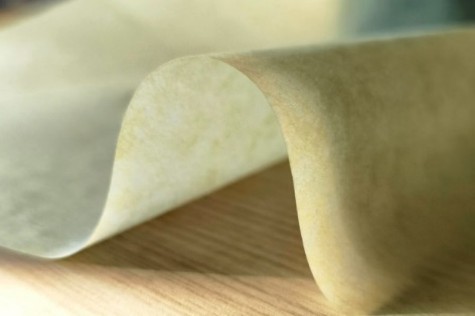
The paper used for electrical insulation is a 100% para-aramid (PPTA) sheet made by a wet-laid papermaking route and then hot-pressed, with para-aramid nanofibers acting as the binder matrix and short para-aramid staple fibers as the reinforcement. That construction is why the sheet behaves like paper on a slitting line and like an engineering material in service: it is flexible enough to wrap around a conductor, tough enough to survive a wire being pushed past it, and it does not melt.
The absence of a melting point is the property that matters most in a fault. Polyester film softens, shrinks and can retract away from a hot spot; aramid paper simply chars and holds its shape, so the clearance it was providing does not disappear at the moment it is most needed. The sheet decomposes in the region of 550 °C, and its dimensional change is quoted below 0.05% after 40 minutes at 300 °C — a figure that matters more than it looks, because it is the difference between a clearance that survives resin cure and one that closes.
Compared with film insulation, the trade is straightforward. Film wins on breakdown voltage per micron and on dielectric loss. Aramid paper wins on conformability, varnish and resin absorption, edge toughness, compressibility under clamping pressure and non-melting behaviour. In a Class H motor slot, a dry-type transformer barrier or a battery module separator, those four advantages usually decide the design, and the film is used only where space is the binding constraint.
Where the Paper Sits in Each Machine
The same sheet is asked to do very different jobs depending on where it is placed. Specifying one grade for every position is how designs end up either over-thick and impossible to wind, or under-thick and damaged during assembly. The table below maps positions to functions, and to the mechanism that actually destroys the insulation in service.
| Equipment | Typical position | Job the paper does | Dominant failure mechanism |
|---|---|---|---|
| Oil-filled transformer | Layer insulation between turns, barrier between windings, end insulation | Turn-to-turn and winding-to-winding withstand, oil impregnation, mechanical support under clamping | Residual moisture, oil ageing products, fibre shedding into the oil |
| Dry-type transformer | HV to LV barrier, layer insulation, cooling channel spacers | Thermal headroom to Class H and above, bonding with cast resin, clearance retention through cure | Voids and partial discharge, cracking from thermal cycling, resin adhesion loss |
| Random-wound motor | Slot liner, phase insulation, wedge and top stick | Mechanical protection during wire insertion, Class H thermal endurance, varnish retention | Torn liner from wire ends and slot burrs, incomplete varnish coverage |
| Form-wound motor and generator | Turn insulation, coil wrap, slot liner, end-winding tape | Turn-to-turn impulse withstand, corona resistance at the slot exit | Steep voltage fronts from inverter drives, loose coils, corona erosion |
| EV battery pack | Cell-to-cell and module barrier, busbar wrap | Thermal barrier and dielectric isolation, no melt drip under a thermal event | Compression cycling, edge tear during assembly, local hot spots |
| High-temperature and fire-resistant cable | Tape wrap and fire barrier under the sheath | Circuit integrity under fire, thermal shielding of the core | Tape overlap and binder choice, mechanical damage at pulling |
Two positions deserve a warning. The first is the layer insulation of a foil-wound transformer, where the paper is compressed at high pressure and any thickness variation becomes a local dielectric weak point. The second is the slot liner of a random-wound motor, where the paper is not really an electrical component at all until the winding is finished — it is a mechanical part that must survive the winding operation before it can do its electrical job.
The Numbers That Govern the Design, and the One That Is Usually Missing
Four properties do most of the work in a specification. Only three of them normally appear on a datasheet, and the fourth is the one that decides whether the first three are delivered in practice.
- Thermal class. IEC 60085 places Class B at 130 °C, Class F at 155 °C, Class H at 180 °C and Class C above 200 °C. Aramid paper can sit in a Class H or Class C design because it does not melt, but the class belongs to the insulation system, not to the sheet: it is proven with your varnish, your magnet wire and your impregnation route, through IEC 60216 data or a UL 1446 system recognition. A paper datasheet claiming Class H tells you the material is capable, not that your motor is.
- Dielectric strength. Useful as a screening number, dangerous as a design number. Short-time breakdown strength measured per IEC 60243 falls sharply with thickness, with temperature, with moisture and with the presence of voids. Design to partial discharge inception in the finished insulation, and treat the datasheet figure as an upper bound that your process will never reach.
- Mechanical strength and tear. The 531 and 532 series are quoted at 2,500 N/m or more in the machine direction and 1,800 N/m or more in the cross direction, with tear strength of at least 1,800 mN in both directions. These are the numbers that predict whether the sheet survives slitting, punching and winding without an edge nick that later becomes a crack.
- Dimensional stability. Below 0.05% change after 40 minutes at 300 °C means the sheet holds its dimensions through resin cure and varnish bake. In a dry-type transformer with tight clearances, this is worth more than an extra 10% of breakdown strength.
The missing number is moisture content at the moment of impregnation. Aramid paper is hygroscopic. It will equilibrate with the air in your stores, and a roll that has been open for a week in a humid month carries water into the vacuum tank. That water depresses insulation resistance, raises dielectric loss and, worst of all, leaves vapour pockets that become partial discharge sites once the resin cures around them. No datasheet value survives that.
Drying and Impregnation Decide the Result More Than the Grade Does
Treat drying as a process step with a measured endpoint, not as a fixed dwell time. The reliable way is to dry a coupon alongside the production load and check its weight loss, or to use a moisture analyser on samples pulled from the oven, until the curve flattens. Oven temperature and vacuum level should be set from the resin supplier's cure schedule and the paper's tolerance, not copied from the last programme.
Impregnation then has to do two things at once: fill the porous sheet so that no void is left inside the insulation wall, and bond the layers so that the winding behaves as a solid block under load. Aramid paper absorbs resin well, which is an advantage only if the resin is where it needs to be. Common defects are dry patches where the paper was too tightly wound for the resin to penetrate, resin-starved corners at a crease, and varnish that skins over before the vacuum is released. All three show up later as partial discharge, not as a failed incoming inspection.
After cure, verify with insulation resistance and dissipation factor at the working voltage and temperature, and with a partial discharge measurement per IEC 60270 where the application justifies it. These are the measurements that tell you whether the process delivered the design, and they are the ones worth trending lot by lot.
Specifying aramid paper for a Class H winding or a dry-type transformer barrier? Send us the thermal class, the impulse level, the impregnation route and the position in the winding. We will confirm the 531 or 532 series, the sheet dimensions and the data package you need for qualification. Talk to our technical team.
Transformers: Layer Insulation and Barrier Insulation Are Two Different Purchases
In a transformer, layer insulation and barrier insulation are often bought as the same material in different thicknesses, which is a mistake in both directions. Layer insulation sees only the turn-to-turn voltage, but it must be thin enough that the winding fits and consistent enough that the interleaving capacitance is predictable. Barrier insulation sees the full impulse between windings, so thickness and mechanical integrity under clamping dominate, and a puncture there is a winding failure rather than a turn fault.
For oil-filled units, compatibility with the insulating oil is part of the specification. The paper must not shed loose fibre into the oil, must not introduce ionic contamination, and must age consistently with the oil and the thermally upgraded kraft it sits beside. Ask for the oil compatibility statement together with the paper data, and confirm the oil type — mineral oil and natural ester behave differently towards the same cellulosic and aramid surfaces.
For dry-type units, the thermal argument is stronger. The paper's headroom above Class H is what allows a higher winding temperature rise, and therefore a smaller core and less copper, without shortening life. The price is that everything bonded to the paper must tolerate the same temperature: the cast resin, the varnish, the spacers and the lead insulation. Structural components in the same transformer, such as clamping blocks and lead supports, are a separate material decision — our laminated densified wood for transformer insulation covers that side of the build.
Motors and Generators: The Drive Has Changed the Requirement
A motor fed from the grid sees a sinusoidal voltage at line frequency. A motor fed from a PWM inverter sees repetitive pulses with rise times measured in tens of nanoseconds, and a drive built around silicon carbide switches makes them faster still. The voltage distribution across the first turns of a winding is no longer linear, so turn insulation that was adequate for fifty years of grid operation can fail in a few years on an inverter.
That is why the qualification question has moved from "what is the breakdown voltage of the paper" to "how does the insulation system behave under repetitive impulses". IEC 60034-18-41 separates Type I systems, which are expected to endure without partial discharge, from Type II systems, which are designed to withstand it. The test is run on a model coil built with your wire, your paper and your impregnation, not on a sheet. If your application is inverter duty, ask the material supplier what they can support at that level and expect the answer to involve your process, not just their product.
For random-wound machines the priorities are more mechanical than electrical. The slot liner has to survive wire insertion without being cut by the slot edge or the wire end, the phase insulation has to stay in place while the winding is laced, and the wedge has to hold tension without crushing the paper. A thicker sheet is not automatically better: it reduces copper fill, forces more turns to be pushed in by force, and can increase the damage you were trying to prevent. The right thickness is the thinnest one that survives your winding line, confirmed by sectioning a stator after varnish and looking for deformation and resin voids.
Wind turbine generators add thermal cycling at low frequency and a service life measured in decades, often in a humid or coastal environment. There, the moisture argument returns: a generator that is dried correctly at manufacture and sealed against ingress will hold its insulation resistance, and one that is not will show a slow decline from the first year.
Battery Packs and Cables: Barrier Duty, Not Winding Duty
In an EV pack the paper is usually a barrier rather than a primary insulator. Its job is to sit between cells or modules and delay heat transfer long enough for the pack to shut down or for the occupant to leave, while maintaining dielectric isolation between cell cans and between busbars and the housing. The relevant behaviours are char formation without melt drip, compression resistance under module clamping, and consistent thickness so that the gap does not vary from stack to stack. The relevant tests are application-specific — ask for the protocol your customer's pack validation uses rather than a generic flammability claim.
In cable, aramid paper appears as a heat and fire barrier tape under the sheath, and in some high-temperature constructions as a wrapped insulation. It is not a drop-in replacement for cross-linked polyethylene in a conventional power cable: the extrusion process, the wall thickness and the moisture-blocking architecture are all built around a different material. Where the paper earns its place is in circuits that must keep working during a fire, and there the tape overlap, the binder and the wrapping tension matter as much as the sheet itself.
Both of these applications sit inside larger systems that our energy storage battery and wire and cable material pages describe from the system side.
The Qualification Tests to Run Before You Release a Lot
Incoming inspection on a paper rarely catches the defects that matter, because the defects are created by the process that uses it. Build the qualification around a model assembly and use the sheet tests only as a consistency check on the lot.
| Test | Reference | What it tells you | Specimen |
|---|---|---|---|
| Short-time dielectric strength | IEC 60243-1 | Breakdown gradient in a defined field, for lot comparison only | Dry sheet, conditioned |
| Permittivity and dissipation factor | IEC 60250 | Dielectric loss at service frequency, and how it moves with moisture | Dry, then after humid conditioning |
| Volume and surface resistivity | IEC 62631 | Leakage path and sensitivity to water uptake | Conditioned sheet |
| Comparative tracking index | IEC 60112 | Surface tracking resistance in polluted, humid conditions | As supplied |
| Partial discharge inception and extinction | IEC 60270 | Voids left by impregnation — the number that predicts life | Impregnated model coil or bar |
| Thermal endurance of the system | IEC 60216, UL 1446 | The class your insulation system can actually claim | Twisted pair or motorette with your varnish |
| Tensile and tear strength | ISO 1924, ISO 1974 | Runnability, edge tear and safe winding tension | Machine and cross direction strips |
| Dimensional stability | Supplier method, 300 °C for 40 minutes | Clearance retention through cure and bake | As supplied |
Ask for the method beside every number. A dielectric strength quoted without electrode geometry and specimen thickness cannot be compared with another supplier's figure, and a thermal class quoted without the system it was tested in cannot be used in a design review. Where a supplier cannot state the method, treat the value as marketing.
Process Details That Cost More Than the Material
Most yield loss with aramid paper happens before the product is energised. The following points are worth writing into the work instruction, because they are cheap to control and expensive to discover late.
- Slit edge quality. A dull knife produces a burr that starts a tear under winding tension. Specify edge condition and inspect a slit roll under magnification at the start of each lot.
- Punching and cutting. Punched windows and notches delaminate if the die clearance is wrong. For thin sheets, a sharp die and a hard backing give a cleaner edge than a laser, which leaves a charred rim.
- Creases at corners. A crease is a thickness reduction and a potential void at the same time. Set a minimum bend radius for each thickness and train the winders to fold rather than force.
- Winding tension. Aramid paper is strong in tension but notch-sensitive. Tension should be set per unit width and checked with a tensiometer, not by feel.
- Cleanliness. Dust and fibre are dielectric weaknesses in oil and void sources in resin. Keep slitting away from winding, and cover rolls between shifts.
- Storage and traceability. Keep rolls sealed with desiccant, use first in first out, and record the opening date. Map each roll to the serial numbers it went into, so a lot issue can be traced to units rather than to a warehouse.
Supplier Verification and the Commercial Terms to Confirm
Aramid paper for electrical use is a qualification purchase, not a commodity purchase, so the supplier audit should confirm three things: that the mill controls the papermaking and hot-pressing process rather than trading sheet, that the quality system covers the product you are buying, and that the supply terms match the pace of your qualification programme.
Our aramid paper is produced by Jufang New Materials, established in July 2018 as a joint venture between Shandong Chambroad Holdings and Tsinghua University, and sold under the Qianbolun brand. The management system certificates held for the aramid paper, yarn, nanofiber and resin operations are ISO 9001 under certificate 05326Q00173R201, ISO 14001 under 05324E30213R1M and ISO 45001 under 05326S00131R201, issued by Beijing NGV Certification. These are China-market certificates covering the manufacturing system; they are not a substitute for the product-level approvals your own market requires, such as a UL insulation system recognition or a customer-specific qualification, and we will tell you plainly which documents we can supply and which your own approval body has to issue.
Commercial terms for the 531 and 532 series are quoted at a capacity of 10 tonnes per month, a minimum order of 20 kg, a lead time of 30 to 60 days, EXW Boxing, payment by bank transfer, and 100% inspection before shipment. Thickness, sheet and roll dimensions and packaging are made to order, and technical support is available remotely and on site during qualification and first production.
A request for quotation gets a useful answer faster when it contains:
- Equipment type and insulation position, with the thermal class you are designing to
- Required thickness with tolerance, and whether the thickness is fixed by dielectric clearance or by mechanical abuse
- Sheet size or roll width, core diameter and the direction you need in the roll
- Impregnation route and resin or varnish system, so compatibility can be confirmed
- The test data you need with methods, and whether a model coil or motorette sample is required
- Annual volume, first order quantity and the date you need material on the winding line
The grade series and the current data sheet for the paper are on the 1414 para-aramid paper (Qianbolun 531) page, and the wider material family, including nanofibers and powder, is under aramid materials. If you are still deciding between para-aramid and meta-aramid for a given position, our thermal and mechanical comparison sets out where the two families diverge.
Qualifying aramid paper for a transformer, motor or battery barrier?
Send the winding position, thermal class and impregnation route. We will confirm the grade series, share the current data sheet and supply sheet samples for your own model-coil trials.
Request a Sample